
Not long ago, getting your website on top of Google SERP was everything. If your website appeared on the first page, you had a good chance of getting clicks and reaching your audience.
But that is changing fast.
Now, people are not always clicking through to websites to get an answer.
Someone might ask ChatGPT a question. Someone else might use Perplexity. Another person might type the same question into Google and get an AI-generated answer at the top of the page. In all three cases, the person may get what they need without visiting the websites that provided the information.
That changes things for content creators and marketers.
That means being visible in search is no longer just about ranking on Google. If your content isn’t also structured in a way that AI systems can understand, use, and surface in their answers, you could be missing valuable opportunities to reach people where they are already searching.
And this is where the conversion around GEO (Generative Engine Optimization) comes in.

GEO stands for Generative Engine Optimization. In simple terms, it is about making your content easier for AI systems to understand, trust and potentially reference when generating an answer.
SEO (Search engine optimization) still matters. In fact, you shouldn’t think of GEO as the replacement for SEO. SEO helps your content compete for visibility in traditional search, while GEO is concerned with visibility within AI-generated answers.
You could put it this way:
SEO helps you rank. GEO helps you get referenced.
But before we get into their differences, there is something important to understand: SEO and GEO actually have quite a bit in common.
What SEO and GEO Have in Common
At the most basic level, both are trying to solve the same problem: how do you get your content in front of the people who need it?
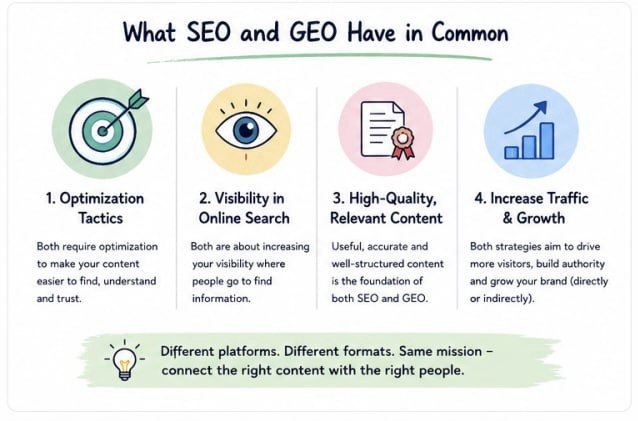
They both involve optimization. They both depend on useful and relevant content. And they both require you to understand what people are actually looking for.
For example, if someone searches for “how to start a small business in Nigeria,” simply repeating that keyword throughout an article won’t make the content useful.
You need to answer the question properly.
What does the person need to know? What steps should they take? What information might they be missing? Can you explain it clearly enough that they don’t have to search five other pages for the answer?
That matters for SEO. It also matters for GEO.
The difference is what happens after that.
With SEO, you’re trying to convince a search engine that your page deserves a place in its results.
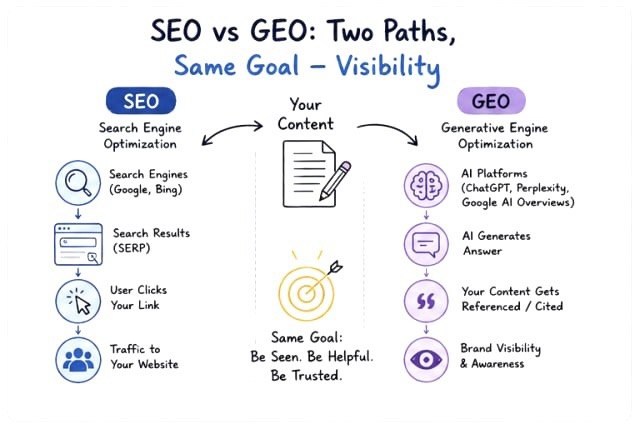
With GEO, you’re also thinking about whether the information on that page is clear and useful enough for an AI system to understand and draw from when answering a question.
So, while the two approaches overlap, they don’t measure success in exactly the same way.
SEO vs GEO: Where They Start to Differ
The easiest way to understand the difference is to look at where your content needs to appear and what you want it to do there.
1. Where you want to be seen
SEO: Your goal is visibility in traditional search results, such as Google’s search results page.
GEO: Your goal is visibility within AI-generated answers, such as Google’s AI Overviews, ChatGPT or Perplexity.
This doesn’t mean SEO only matters on Google or that GEO only applies to one particular AI tool. The point is that the two strategies are designed around different ways of finding information.
2. What you are trying to achieve
SEO has traditionally been very click-focused.
You want someone to see your page in the search results, click the link and visit your website.
GEO works a little differently.
An AI platform may use information from your content to answer someone’s question without sending that person directly to your website. Your brand could still get mentioned or cited, even if there is no immediate click.
That makes visibility and exposure important alongside traffic.
3. What you optimise
SEO looks at many parts of a website and page. Keywords, internal links, backlinks, page structure, technical SEO and other factors can all affect how a page performs in search.
GEO puts more attention on the actual information in your content.
Can the answer be understood on its own? Is the information clearly explained? Does the content show expertise? Are claims supported by credible sources? Can an AI system easily identify the part that answers the question?
This is one reason clear headings, direct answers, useful examples and well-supported information are becoming more important.
4. How people consume the information
With traditional search, the person usually sees a list of results and chooses which link to open.
With AI search, the platform may bring information from different sources together and give the person a summary.
That changes the role your content plays.
Your page is no longer only trying to be the result someone clicks. It can also become one of the sources used to build the answer.
And that is probably the biggest difference between SEO and GEO.
So, Do You Need SEO or GEO?
Honestly, why choose?
You still need SEO. The search engines people have been using for years haven’t disappeared. And AI platforms don’t exist in some completely separate internet where everything works from scratch. They still depend heavily on information that already exists across the web.
What is changing is the way that information is being found, processed and presented to people.
That means your content strategy needs to account for both.
Create content people actually want. Make it easy to find. Make it easy to understand. Support your claims. Answer questions properly. Then think about how that same content can be understood by AI systems.
You don’t need to throw away everything you’ve learned about SEO.
You just need to stop thinking that ranking is the only way people will discover your content.
The search box has changed. The goal of good content hasn’t.